(424) 242-1130
Reddit User Asks
“Sober Living that isn't an Oxford House?”
“Looking for alternatives to oxford house — having trouble finding oxfords with openings.”
“Now my house gives me an ultimatum... with the new rotation of members they are all super gung ho on AA and do not like that I am not attending.”
— r/REDDITORSINRECOVERY
Sober living homes can look similar from the outside while operating quite differently once you move in. One of the biggest differences is who runs the home.
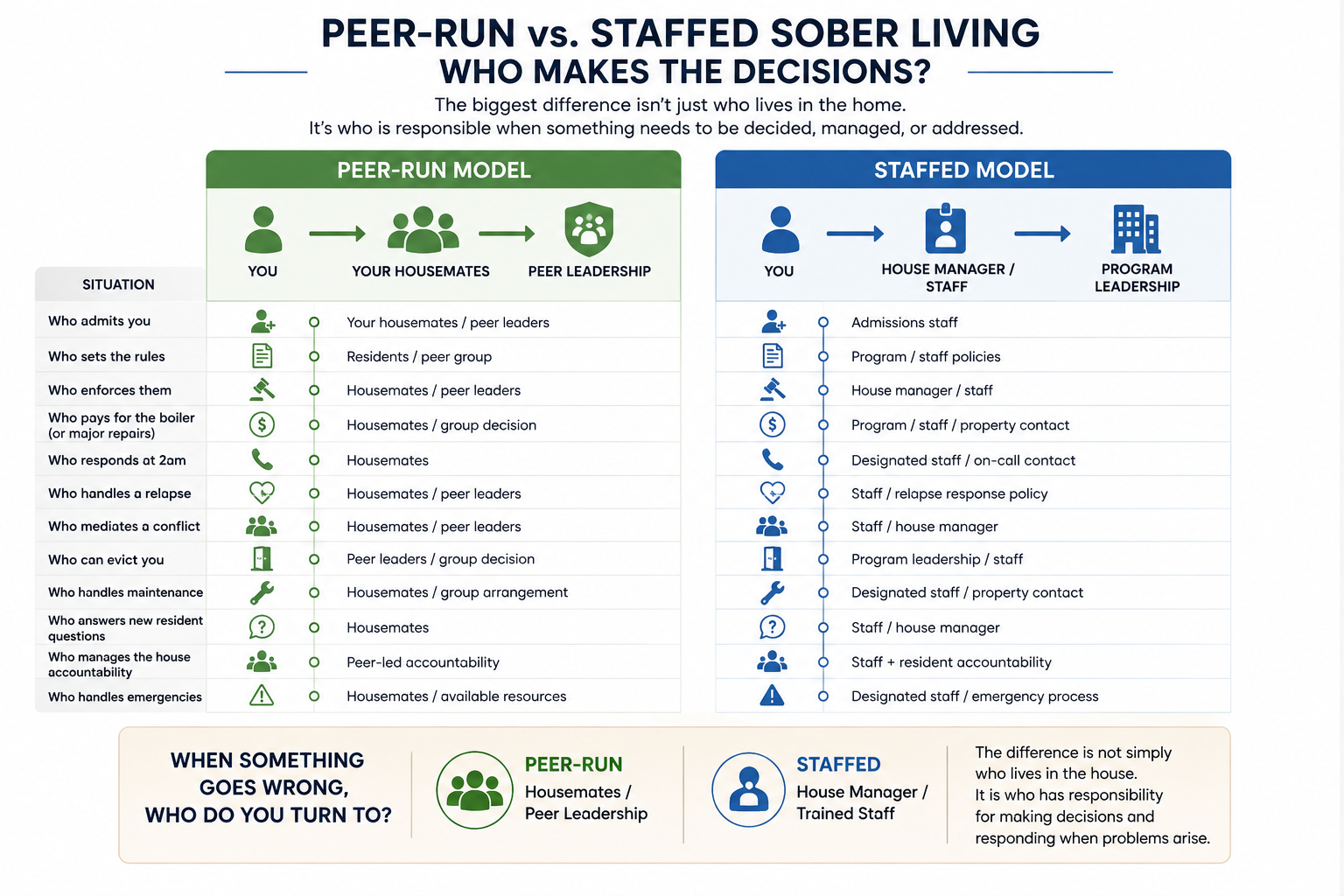
Oxford House follows a peer-run model in which residents govern the house together. A managed sober living home places more day-to-day responsibility with designated house leadership.
That difference can affect admission, household decisions, expenses, and how everyday concerns are handled. Some people prefer having a direct vote in what happens at home. Others want designated oversight and a clear person responsible for house operations.
The questions above reflect some of the reasons people compare these models, from wanting an alternative to Oxford House to concerns about availability and how resident-led decisions can affect everyday life. Neither approach is automatically better. The useful comparison is how each model operates and what you want from the place where you'll be living.
Two Different Approaches to Sober Living
Oxford House and managed sober living both provide alcohol- and drug-free housing, but responsibility inside the home is organized differently.
The National Alliance for Recovery Residences (NARR) classifies peer-run residences as Level I and monitored residences as Level II. Oxford House is the best-known example of Level I housing. Level II residences usually have a senior resident appointed by the owner or operator as house manager.
How Oxford House Works
Oxford House describes its model around three core requirements: houses are democratically self-run, financially self-supporting, and alcohol- and drug-free. Oxford House currently reports more than 3,500 houses across the United States.
Each house receives a charter from Oxford House, Inc. The charter requires the group to follow the Oxford House system of operations, pay its own bills, and immediately expel a resident who returns to alcohol or drug use.
A few features help explain how the model operates:
- Residents run the house democratically. House decisions are made collectively rather than by an on-site manager.
- New residents go through a house vote. Admission requires an 80% favorable vote from existing members.
- Household responsibilities are shared. Oxford House provides forms for rotating jobs so residents share work around common areas.
- The house supports itself financially. Paying its own bills is one of the conditions of maintaining an Oxford House charter.
- There is no fixed deadline for leaving. Oxford House describes no deadline for moving out as a longstanding part of its model, provided residents continue following the rules.
The Oxford House Manual provides additional guidance on meetings, officers, finances, and everyday house operations.
How a Managed Sober Living Home Works
A managed sober living home places more responsibility for house operations with designated leadership.
NARR describes Level II recovery residences as monitored sober living environments that use house rules and peer accountability. A senior resident appointed by the owner or operator typically serves as house manager. Some Level II residences also provide lower-intensity recovery support or life-skills services, although this is not universal.
A house manager should not be confused with a clinician. Level II classification does not by itself mean a sober living home provides therapy, psychiatric care, or other clinical services.
If designated oversight is important to you, it can also help to understand how Design for Recovery staffs its houses and what responsibilities belong to house leadership.
The core difference here is simpler: residents democratically govern an Oxford House, while a Level II model typically introduces designated oversight alongside peer accountability.
When Oxford House May Work Well
The peer-run approach has genuine strengths. It may appeal to someone who is comfortable sharing responsibility for the home and wants a direct role in household decisions.
Some of the model's defining features include:
- Resident involvement. The people living in the home participate directly in its operation.
- A vote in house decisions. Democratic governance is a core requirement of the Oxford House charter.
- Shared household responsibilities. Residents divide the work involved in maintaining common areas and operating the house.
- A self-supporting financial model. Each house is responsible for paying its own bills.
- No predetermined move-out date. Residents can stay as long as they continue meeting the model's requirements.
This arrangement can work well for someone who wants peers to play a large role in household decisions and is comfortable participating in the responsibilities that come with running the home.
When More Oversight May Help
Peer governance also means the current residents have meaningful influence over everyday life in the house. Some people value that arrangement; others may prefer a home with designated oversight.
A structured sober living environment may be more suitable for someone who prefers:
- A designated person responsible for house operations.
- Less responsibility for governing the home personally.
- House oversight that does not rely entirely on resident voting.
- A clear person to approach about everyday house concerns.
Those are considerations rather than guarantees. Managed sober living homes vary, and the exact responsibilities of a house manager should always be confirmed with the individual provider.
Resident dynamics are another part of shared housing. Because democratic governance gives residents a meaningful role in house decisions, the experience within an individual home can be influenced by the people currently living there. Someone who would rather have designated leadership involved in everyday oversight may prefer a managed model.
At the same time, democratic governance means residents genuinely participate in house decisions. Someone who would rather have designated leadership involved in everyday oversight may therefore prefer a managed model.
Finding an Available Home in Los Angeles
Availability can affect your options regardless of which model you initially prefer.
Oxford House provides a vacancy search that lets applicants look for houses with openings. Its application guidance says prospective residents find a house with a vacancy, complete an application, and interview with the people currently living there.
If an appropriate Oxford House opening isn't available when you need housing, alternatives to Oxford House include managed sober living homes and other recovery residences. Compare the individual home rather than assuming every option outside Oxford House follows the same model.
Which Model Works Better for Your Situation?
Labels only tell you part of the story. These six questions can make the comparison more useful:
1. Are you comfortable with housemates voting on important decisions?
Democratic governance is central to Oxford House.
2. Do you want to participate in running the home?
Oxford House residents share responsibility for household operations.
3. How important is your housing budget?
Compare actual expenses for the homes you're considering rather than assuming every Oxford House or managed home charges the same amount.
4. Would you prefer designated house oversight?
NARR Level II residences typically have a house manager or senior resident serving as head of household.
5. Is an open-ended stay important to you?
Oxford House does not impose a predetermined move-out date on residents who continue meeting its requirements.
6. What kind of household responsibility do you want?
Oxford House places significant responsibility with residents. A managed model places more operational responsibility with designated leadership.
Your answers may point in different directions. Cost could favor one home while location, oversight, or the admission process favors another. The individual residence still deserves attention beyond its category.
Whichever model you consider, look beyond the label and pay attention to how the individual home operates. Knowing what is normal and what may be a red flag in sober living can help you evaluate house expectations, accountability, and the overall living environment before making a decision.
You Don’t Have to Choose One Forever
The type of sober living you want can change over time.
Someone may prefer managed sober living initially and later decide that a peer-run Oxford House is a better option. Another person may be comfortable with the Oxford House model from the beginning.
There is no single timeline that works for everyone. Length of stay depends on the home and its policies, so your housing choice can be revisited as your needs and circumstances change.
A Different Approach to Sober Living
Oxford House can work well for people who are comfortable with a peer-run home and shared responsibility for household decisions.
If you prefer designated house oversight, consistent accountability, and a sober living environment where you are not responsible for governing the home with your housemates, a managed model may be more appropriate for you.
Design for Recovery provides men’s sober living in Los Angeles with community, accountability, and support for building stable everyday routines.
The focus extends beyond having a substance-free place to live, with an environment designed to help residents take responsibility for work, relationships, commitments, and daily life.
- Two Different Approaches to Sober Living
- When Oxford House May Work Well
- When More Oversight May Help
- Finding an Available Home in Los Angeles
- Which Model Works Better for Your Situation?
- You Don’t Have to Choose One Forever
Begin Lasting Sobriety Now!



Frequently Asked Questions About Men's Sober Living in Los Angeles
Yes. Oxford House is a form of recovery housing commonly discussed alongside sober living. NARR identifies Oxford House as the best-known example of its Level I peer-run model.
Oxford House is designed as a democratically self-run model rather than a Level II residence with a house manager. Residents collectively handle the responsibilities required by the Oxford House system.
Yes. Housing needs can change over time. Someone may choose managed sober living first and consider a peer-run home later, although there is no required order or standard progression.
Yes. Managed sober living homes and other recovery residences offer different approaches. Compare the level of oversight, household responsibilities, admission process, cost, location, and rules of each home rather than treating all alternatives as the same.
Level I residences are peer-run and democratically governed. Level II residences use house rules and peer accountability but typically add a house manager or senior resident appointed by the owner or operator.
- National Alliance for Recovery Residences. (n.d.). Standards. https://narronline.org/standards/
- Reddit user. (2017). Looking for alternatives to Oxford House — having trouble finding Oxfords with openings [Online forum post]. Reddit. https://www.reddit.com/r/REDDITORSINRECOVERY/comments/7f2i0r/looking_for_alternatives_to_oxford_house/
- Reddit user. (2025). Sober living that isn't an Oxford House? [Online forum post]. Reddit. https://www.reddit.com/r/askportland/comments/1ndirzo/sober_living_that_isnt_an_oxford_house/