(424) 242-1130
Reddit User Asks
“It seemed the house managers and more seasoned sober people had a superiority complex because of their length of sobriety. I also found how incredibly fake and cliquey it was. Similar to high school. And THE DRAMA.”
“Forcing residents for labor for their contracting calling it service work. The owner loves hiring his residents so he has complete and utter control over them.”
— r/Sober
A sober living house manager can have an important day-to-day role in a shared home. For residents, the important questions are not only who is in charge, but what that person's responsibilities are, how decisions are made, and what happens when a concern comes up.
The experiences above raise two different concerns about house leadership: how authority is used within the home and where ordinary household responsibilities end. One person's experience should not be treated as representative of every sober living home, but these are reasonable issues to clarify before moving in.
Knowing who handles everyday concerns, what authority a house manager has, and who you can speak with if a problem involves the manager can tell you a great deal about how a home operates.
Who Is Responsible for Running a Sober Living Home?
There is no single staffing model used by every sober living home. Some residences have a designated house manager overseeing everyday operations, while others divide responsibilities among several staff members. Peer-run models can work differently again.
Research on sober living houses illustrates this variation. In a study of 35 sober living house managers, researchers found substantial differences in how managers approached their roles. Some spent considerable time interacting with and supporting residents, while others viewed their responsibilities as primarily administrative.
An Oxford House sober living residence offers a useful contrast. Oxford Houses use a peer-run model rather than the same type of designated management found in some other sober living homes.
The differences between Oxford House and managed sober living are especially noticeable in how responsibility for house operations and everyday decisions is organized.
Different models can work for different people; the important point here is that prospective residents should understand who runs the sober living home they are considering and how responsibilities are divided.
That means asking more than simply, “Is there a house manager?” It is useful to understand who handles everyday concerns, who makes larger decisions, and whether someone else is available when a situation goes beyond the manager’s role.
What a House Manager Does
The exact responsibilities of a sober living house manager can differ between homes. Research from Los Angeles sober living houses found that managers’ roles and the amount of time they spent on different responsibilities varied considerably.
That makes it difficult to create one job description that accurately represents every sober living residence.
Day-to-Day Responsibilities
House managers may be involved in the everyday operation of the residence and in communicating established expectations to residents.
The Los Angeles study found managers performing responsibilities involving house rules, rent and bills, repairs, and general house operations. The researchers also found substantial differences in how much individual managers interacted with residents.
Depending on the home, everyday responsibilities might therefore involve:
- Communicating house expectations.
- Helping coordinate routine household matters.
- Addressing questions about shared spaces or responsibilities.
- Responding when an everyday issue comes up.
- Helping maintain consistency in how the home operates.
- Passing concerns to another appropriate person when the issue falls outside the manager’s role.
House manager responsibilities can differ considerably between residences. If you’re looking for a sober living, ask what the manager handles day-to-day and who takes responsibility when an issue falls outside that role.
Training and Support
There is also no reason to assume that every house manager arrives with the same preparation.
Instead of looking for one universal list of sober living staff qualifications, prospective residents can ask practical questions:
- How are house managers selected?
- What preparation do they receive for the role?
- Is ongoing guidance available?
- Who supports or supervises the manager?
- How are questions about a manager’s performance addressed?
These questions can reveal more about a home’s staffing approach than a title alone.
Clear Roles Help Keep Expectations Consistent
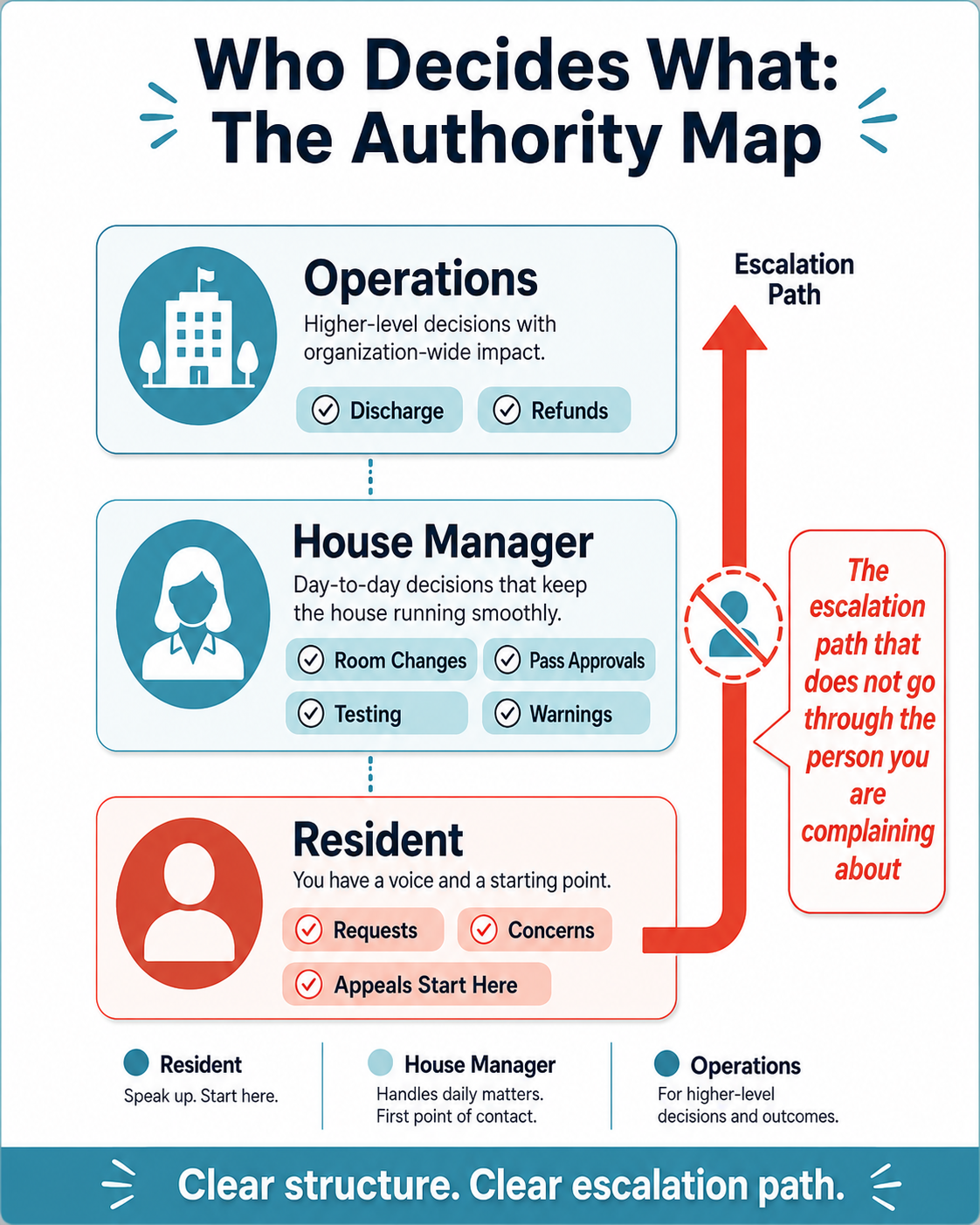
A house manager needs enough responsibility to help the home operate, but the title itself should not leave residents guessing about how decisions are made.
Clear roles help distinguish established sober living house rules and expectations from one person’s preferences. Residents should also be able to understand whether a decision belongs to the house manager or needs input from someone else.
This can be particularly useful for decisions involving:
- Room changes
- Schedule or pass requests
- Testing procedures
- Warnings
- Financial questions
- House expectations
- Decisions affecting someone’s continued residence
The exact authority attached to each of these decisions can differ by residence. Rather than assuming the house manager controls all of them, residents can ask who makes the decision and whether someone else can review it.
Consistency is important as well. Shared living can naturally involve disagreements, different personalities, and residents who have been in the home for different lengths of time. Someone having more time in recovery does not, by itself, explain what formal authority they hold within a particular residence.
Defined roles can help residents distinguish peer experience from the responsibilities formally assigned to a house manager.
Clear leadership is also part of creating a home where accountability does not depend on one person's preferences. Design for Recovery's mission is reflected in an approach that emphasizes responsibility, community, and long-term personal growth.
How House Managers Set Expectations Around the Home
Clear roles also help when it comes to what residents themselves are expected to do.
Shared sober living commonly involves responsibilities around the home. Research on sober living houses has described residents participating in chores, upkeep, and house meetings as part of communal living. That is different from assuming every request made by someone in authority is simply a household responsibility.
Questions can arise when a request goes beyond ordinary responsibilities around the home, particularly when outside work or someone’s business is involved. Some residents have raised concerns about where that line should be drawn.
There can be meaningful differences between:
- Routine household chores.
- Shared responsibilities associated with communal living.
- Voluntary activities.
- Work performed for an outside business.
- Paid employment.
Before moving in, residents can ask what household responsibilities are expected, how often they occur, and whether outside work is entirely separate from ordinary responsibilities within the home.
If paid employment is offered through someone connected to the residence, the terms of that arrangement should also be understood separately from the person’s responsibilities as a resident.
If You Have a Concern About a House Manager
Even when responsibilities are clearly explained, disagreements can happen. A resident may feel that an expectation has been applied inconsistently, disagree with a decision, or simply want another person to review what happened.
The important question is what options are available when the concern involves the house manager themselves.
A resident should not have to discover that process only after a difficult situation develops. Before moving in, it can help to clarify:
- Who can I speak with if my concern involves the house manager?
- Is there someone else who can review the situation?
- How can I raise a concern?
- Can concerns be raised privately?
- How will I know what happens next?
- What options are available if the concern remains unresolved?
The answers will differ between homes. When choosing a sober living home, consider whether the process for raising a concern can be explained before you move in, rather than only after a problem develops.
Choose a Home With Clear Roles and Expectations
A well-run sober living home should make everyday expectations easier to understand. Residents should have clarity around house responsibilities, how decisions are made, and where they can turn when questions or concerns come up.
Design for Recovery provides men’s sober living in Los Angeles with an emphasis on accountability, community, and consistent daily routines. The right living environment can give you a clearer foundation for building steady habits and staying engaged in your recovery.
- Who Is Responsible for Running a Sober Living Home?
- What a House Manager Does
- Clear Roles Help Keep Expectations Consistent
- If You Have a Concern About a House Manager
Begin Lasting Sobriety Now!
Frequently Asked Questions About Men's Sober Living in Los Angeles
A sober living house manager may help oversee everyday house operations, communicate house expectations, respond to routine concerns, and coordinate practical matters. The exact responsibilities can differ between residences.
It depends on the home’s model. Some sober living homes use designated house managers and other staff, while peer-run residences organize responsibilities differently. Asking who handles everyday operations and larger decisions can help you understand the structure of a particular home.
That depends on how the residence divides responsibility. Some decisions may fall within a manager’s day-to-day role, while others may involve additional leadership or established organizational policies. Residents can ask where those boundaries sit before moving in.
Ask whether the home provides another person or process for raising concerns involving the manager. It can also help to clarify how concerns are reviewed and what options are available if the issue remains unresolved.
- Judicial Branch of California. (n.d.). Rule 4.414. Criteria affecting probation. California Courts. https://courts.ca.gov/cms/rules/index/four/rule4_414
- Judicial Branch of California. (n.d.). Drug courts. California Courts. https://courts.ca.gov/programs-initiatives/collaborative-justice-courts/adult-courts/drug-courts
- California Legislative Information. (n.d.). California Penal Code § 1000. California State Legislature. https://leginfo.legislature.ca.gov/faces/codes_displaySection.xhtml?lawCode=PEN§ionNum=1000.