 (424) 242-1130
Reddit User Asks
“If someone is sentenced 11 months in a halfway house after their prison sentence, will they have to finish the entire time given? Also are you allowed to drive yourself to work if you have a vehicle?”
“Well this is it gents. I am on federal probation and I fucked up so now I am going to the federal halfway house. Had to quit a job I loved too.”
Leaving federal custody can mean returning to the community, but it may not mean you can immediately choose where you live or have complete control over your daily schedule.
For some people, the transition includes time in a federal halfway house, where employment, transportation, approved activities, and other parts of daily life may still be subject to specific requirements.
The questions above reflect two sides of that transition. One is practical: how long will you stay, how will you get to work, and what will you be allowed to do? The other is personal: a federal halfway house placement can disrupt employment and other parts of a life you may already be trying to rebuild.
Private sober living is different from a federal halfway house. Understanding the role of each can help you prepare for a federal placement, know which questions to ask while you are there, and consider your housing options when you are able to choose where you live.
Disclaimer: This article provides general information only and is not legal advice. Federal placement, home confinement, supervised release, and housing requirements depend on individual circumstances and applicable rules. Confirm the requirements that apply to you with the appropriate federal authority, supervising officer, or attorney.
What Is a Federal Halfway House and How Does It Work?
If you are wondering what a halfway house after prison is, the federal system commonly uses the term Residential Reentry Center. These facilities help people transition from federal custody back into the community.
The Federal Bureau of Prisons contracts with Residential Reentry Centers, also known as halfway houses, for people nearing release. The agency describes them as supervised environments that can provide employment assistance, financial management help, housing assistance, and other reentry services.
A federal halfway house is therefore different from choosing and renting ordinary housing. Placement is handled through the federal reentry process, and residents remain subject to applicable federal requirements while there.
People searching for federal halfway house locations should also keep that distinction in mind. A federal halfway house for inmates approaching release is not simply a private residence someone selects based on personal preference. Placement decisions are made through the federal system.
The length of a Residential Reentry Center placement can also differ. It should not be assumed that everyone receives the same amount of time or follows exactly the same path back into the community.
Understanding that level of supervision makes the everyday rules easier to put into context.
What Rules Can Apply While Living in a Federal Halfway House?
The phrase halfway house rules for inmates can make it sound as though there is one short list of rules for every facility. Federal requirements establish important expectations, but residents should still confirm the procedures that apply to their particular placement.
Leaving the Federal Halfway House for Approved Activities
Residents generally cannot treat a federal halfway house like an ordinary apartment where they can come and go whenever they choose. Leaving the residence is generally connected to approved activities and applicable sign-out procedures.
The Federal Bureau of Prisons identifies approved activities that can include:
- Employment: Traveling to and from an approved job.
- Job searches: Leaving the residence for approved employment-related activities.
- Visits: Going on visits that have been authorized.
- Recreation: Participating in approved recreational activities.
- Other authorized activities: Leaving for additional purposes permitted under the applicable rules.
Residents may also be subject to accountability measures, including scheduled and random counts and monitoring while away from the facility.
Before planning around a particular schedule, confirm what approval is required, how leaving and returning are documented, and what you should do if an unexpected delay affects your return.
Testing and Other Residence Requirements
Accountability can continue after someone returns to the residence. The Federal Bureau of Prisons states that residents may receive random substance testing when they return from approved activities.
Other expectations may apply to your individual placement. Rather than relying on another resident's experience, learn the requirements of your particular center and ask questions when a rule is unclear.
One of the biggest questions is how long those requirements remain part of daily life.
Do You Have to Stay for the Full Federal Halfway House Placement?
Being told that you have a certain amount of Residential Reentry Center time does not, by itself, tell you exactly how the remainder of your federal custody will unfold.
The First Step Act expanded opportunities for eligible individuals to earn time credits that can qualify them for prerelease custody. The Federal Bureau of Prisons identifies both Residential Reentry Centers and home confinement as forms of prerelease custody. Eligibility and application of credits depend on federal requirements and the person's circumstances.
That is why someone should not assume either that they must remain in the halfway house for every originally anticipated day or that they will automatically move to home confinement earlier.
The Federal Bureau of Prisons also makes clear in its First Step Act guidance that at least some eligible individuals may transfer directly from an institution to home confinement without first going through a Residential Reentry Center.
If you have been given a particular placement period, ask the appropriate federal staff what that period means for you and whether any other form of prerelease custody may apply.
During whatever time you do spend in the residence, employment and transportation can become central parts of your routine.
How Do Employment and Transportation Work in a Federal Halfway House?
Working While Living in a Federal Halfway House
Returning to work can be an important part of reentry, but living in a federal halfway house means employment has to work alongside the residence's accountability requirements.
Residential Reentry Centers can help residents look for employment. According to the Federal Bureau of Prisons, this assistance may include:
- Local employer connections
- Job fairs
- Résumé preparation
- Interview training
Federal guidance also states that residents are ordinarily expected to obtain full-time employment within a specified period after arriving. Work is an approved reason for leaving the residence, but applicable sign-out and accountability procedures still apply.
Employment may remain important after federal placement. Men considering sober living can learn more about employment support when planning their next living arrangement.
Employed residents should also confirm whether a subsistence payment applies and what contribution may be required for their particular placement.
Using a Personal Vehicle for Work While in a Federal Halfway House
Having a car does not automatically mean you can use it to travel to and from work while living in a federal halfway house.
Federal Bureau of Prisons guidance explains that residents need authorization to leave for approved activities, but its public Residential Reentry Center guidance does not specify whether residents may use personal vehicles to travel to work.
Before depending on your vehicle for work, ask your particular center:
- Are residents permitted to use personal vehicles?
- Does the vehicle or driver need prior approval?
- What documents do I need to provide?
- How should my work and travel schedule be reported?
- What should I do if my vehicle breaks down or I cannot return at the expected time?
That last question is especially useful. A transportation problem does not remove an accountability requirement, so knowing whom to contact before something goes wrong can prevent unnecessary confusion.
Eventually, the bigger question becomes what happens when the federal halfway house is no longer where you live.
What Comes Next for Housing and Supervision After a Federal Halfway House?
Leaving a federal halfway house does not necessarily mean federal oversight has ended. Some people may transition to home confinement, while others may have a period of supervised release after completing their custodial sentence.
Where you live can still be relevant. If you will be under supervision after leaving the Residential Reentry Center, confirm whether your proposed address needs to be reported, reviewed, or approved before you move.
This is also where private sober living may become relevant for some men. If you are permitted to choose private housing and want a substance-free environment with community and accountability, sober living can be one option to consider.
Understanding how a sober living program works can help you decide whether this type of environment aligns with your needs after release.
It does not replace federal requirements, and choosing a sober living home does not override conditions that apply to your release.
How Is Private Sober Living Different From a Federal Halfway House?
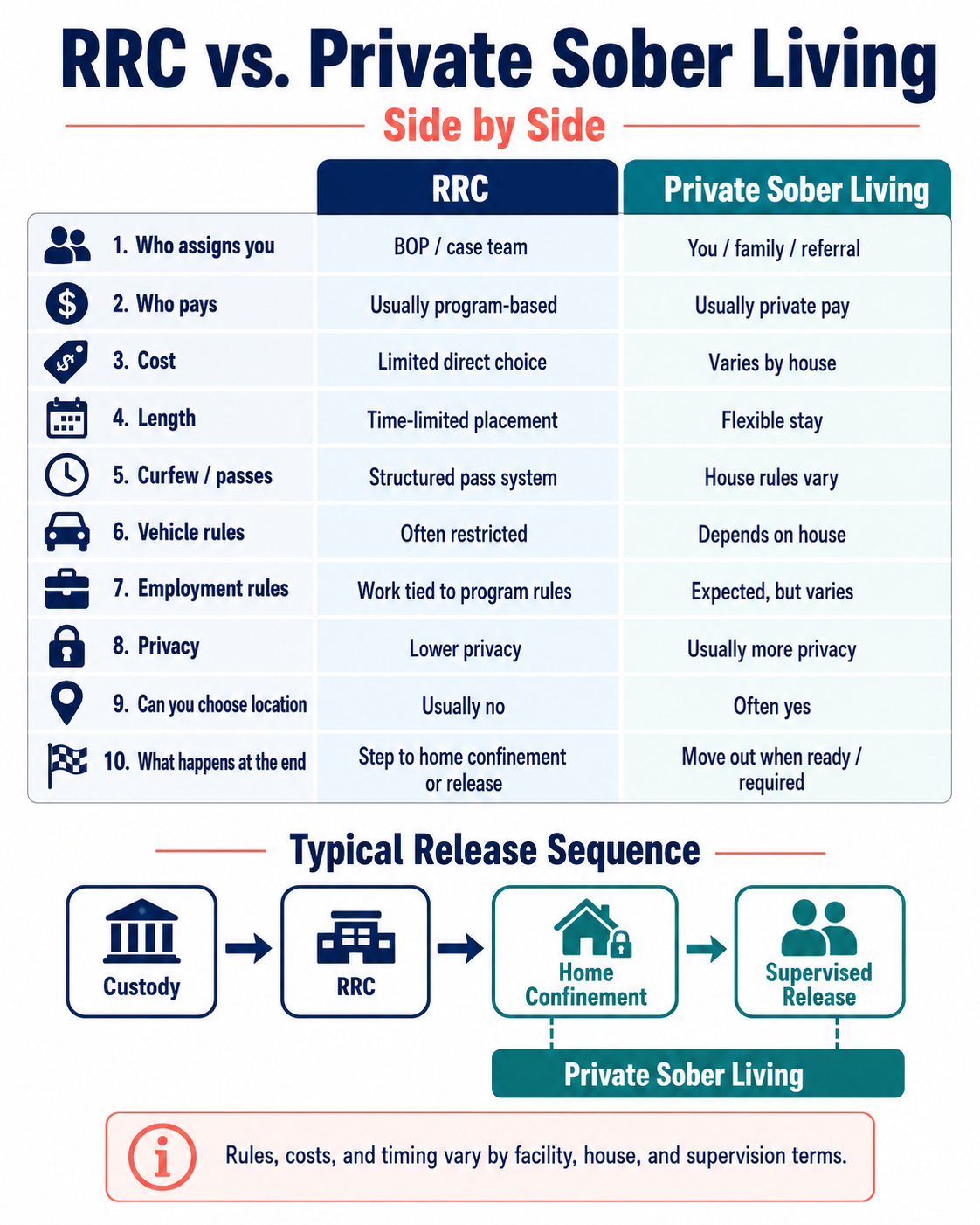
Private sober living is not another form of federal prerelease custody. A federal halfway house is part of a federally arranged reentry process, while private sober living is a housing option someone may choose when their circumstances and supervision requirements allow it.
Some of the main differences involve:
- Housing choice: Private sober living may offer more choice over where you live.
- Daily expectations: Residents follow the sober living home's house rules rather than federal custody requirements.
- Employment: Residents can plan work around the expectations of the home and any supervision requirements that still apply.
- Living environment: Sober living provides a substance-free home with community and accountability.
- Length of stay: The stay is not determined in the same way as a federal pre-release placement.
If your housing is connected to a court or supervision requirement, confirm what is required before choosing a residence. The requirements around court-ordered sober living can differ depending on the person's circumstances and applicable conditions.
What Should You Confirm Before Moving Into Sober Living After Release?
Before arranging sober living after custody or a federal halfway house, find out what housing requirements still apply to you.
Useful questions include:
- Am I permitted to choose my next residence?
- Does the address need to be approved before I move?
- What information about the residence needs to be provided?
- Are there restrictions that could affect where I live?
- How will the location work with my employment and transportation?
- What do I need to complete before my move date?
Once those questions are clear, you can discuss the housing side with the sober living provider.
Design for Recovery provides men's sober living in Los Angeles. If you are considering one of our homes after release, you can review the admission process and speak with the team about the residence, current availability, house expectations, and information needed for admission.
A housing plan is only one part of reentry. Identification, transportation, benefits, and employment may need attention at the same time.
What Reentry Resources Are Available in Los Angeles?
Getting established in Los Angeles can involve several practical tasks. Rather than trying to solve everything through the housing provider, it can help to know which local resources handle different needs.
Identification and Benefits
Identification can be necessary for employment, housing, banking, benefits, transportation, and other everyday needs. Los Angeles County's reentry materials specifically identify documents as an important part of accessing these services.
Los Angeles County reentry resources also bring together information for people with justice involvement, including employment programs, training, and other forms of assistance.
Transportation in Los Angeles
Transportation after release is a different issue from whether a federal halfway house permits you to drive a personal vehicle.
If you rely on public transit in Los Angeles, Metro's LIFE program offers reduced-fare benefits to qualifying Los Angeles County residents. Check the current eligibility requirements to see whether you qualify.
Reliable transportation can make it easier to plan around work, appointments, meetings, and other responsibilities after release.
Employment and Reentry Support
Los Angeles County RENEW Program also maintains reentry-focused employment resources. Its current programs include employment navigation, training, and opportunities specifically intended for people with justice involvement.
Reentry does not always unfold according to the original plan. Housing can change unexpectedly, and sometimes a person needs to rebuild a routine after another transition.
Although leaving custody and leaving a sober living home are different circumstances, starting over after a discharge can involve some of the same practical priorities, such as finding stable housing and rebuilding a daily routine.
Preparing for Your Next Living Environment After Release
A federal halfway house and private sober living should not be treated as interchangeable. One is part of the federal reentry system, while the other is a private substance-free living environment that may become an option when someone's circumstances and applicable requirements allow it.
Before choosing housing, confirm what federal or supervision requirements still apply. Then consider the day-to-day questions that can affect your transition, including employment, transportation, house expectations, and the kind of community you want around you.
Design for Recovery can help you understand what to expect from men's sober living in Los Angeles and whether one of our homes may be appropriate for your next step.
- What Is a Federal Halfway House and How Does It Work?
- What Rules Can Apply While Living in a Federal Halfway House?
- Do You Have to Stay for the Full Federal Halfway House Placement?
- How Do Employment and Transportation Work in a Federal Halfway House?
- What Comes Next for Housing and Supervision After a Federal Halfway House?
- How Is Private Sober Living Different From a Federal Halfway House?
- What Should You Confirm Before Moving Into Sober Living After Release?
- What Reentry Resources Are Available in Los Angeles?
Begin Lasting Sobriety Now!



Frequently Asked Questions
In the federal system, the term commonly refers to a Residential Reentry Center. The Federal Bureau of Prisons contracts with these centers to provide supervised community-based placements and reentry assistance for people nearing release.
Not necessarily in every circumstance, but an individual should not assume their placement will be shortened. Federal rules, eligibility, time credits, and individual circumstances can affect prerelease custody. Confirm what your assigned period means with the appropriate federal authority.
Yes, employment can be part of federal reentry planning. Residential Reentry Centers assist residents with employment, and work can be an approved reason for leaving the residence under applicable procedures.
No. Both can be forms of federal prerelease custody, but home confinement and placement in a Residential Reentry Center are different arrangements.
It may be possible when private sober living is consistent with the housing and supervision requirements that apply to you. Confirm any address or residence requirements before arranging the move.
- Reddit user. (2024). Halfway house (Dismas) [Online forum post]. Reddit. https://www.reddit.com/r/probation/comments/1axipe6/halfway_house_dismas/
- Federal Bureau of Prisons. (n.d.). Residential reentry centers. U.S. Department of Justice. https://www.bop.gov/PublicInfo/execute/rrc?todo=query
- Federal Bureau of Prisons. (n.d.). First Step Act: Frequently asked questions. U.S. Department of Justice. https://www.bop.gov/inmates/fsa/faq.jsp
- Los Angeles County Department of Mental Health. (n.d.). Re-entry resources. County of Los Angeles. https://dmh.lacounty.gov/our-services/ee/resources/re-entry-legal/
- Los Angeles County Metropolitan Transportation Authority. (n.d.). LIFE program. https://www.metro.net/fares/life/
- Los Angeles County Department of Economic Opportunity. (n.d.). RENEW. County of Los Angeles. https://opportunity.lacounty.gov/renew/
- Reddit user. (2024, May 28). Federal halfway house [Online forum post]. Reddit. https://www.reddit.com/r/Prison/comments/1d256d4/federal_halfway_house/


Written By
David Beasley