 (424) 242-1130
Reddit User Asks
“This is the third halfway house I have been kicked out of. I have only been here for a month and now I am getting discharged. I disappointed everyone in my family i fucked everything up for the hundredth time. My dad does not want me back home, my sister thinks I am a failure, i can hear it in her voice when she talks to me.”
Having a second or third sober living stay does not mean the next one has to follow the same pattern. But when a previous stay has ended unexpectedly, it can be difficult to separate what happened from the shame that may come with it.
If you recognize some of that experience, the useful question is not whether you have already had too many chances. It is what contributed to the previous stay ending and what needs to be different before you choose another home.
A sober living second chance should not mean simply repeating the same arrangement and hoping for a different result. Looking carefully at the home, your circumstances, and the support you currently need can give you a clearer starting point.
Start With What Happened During Your Last Sober Living Stay
A discharge tells you that something did not work during that particular stay. It does not tell you, by itself, what the problem was.
Before looking for another sober living home, think specifically about what happened before the previous stay ended.
Ask yourself:
- Was I unable to keep up with the cost?
- Did my work schedule conflict with house expectations?
- Was there ongoing conflict with another resident?
- Did a relationship outside the home affect my decisions?
- Did I struggle when I had too much unplanned time?
- Were mental health concerns becoming harder to manage?
- Did substance use contribute to the discharge?
- Were the home's expectations different from what I expected?
More than one answer may apply.
The purpose of this self-audit is not to assign blame. It is to identify something specific enough to change. If you only conclude that the last attempt “didn't work,” you have very little information to use when choosing what comes next.
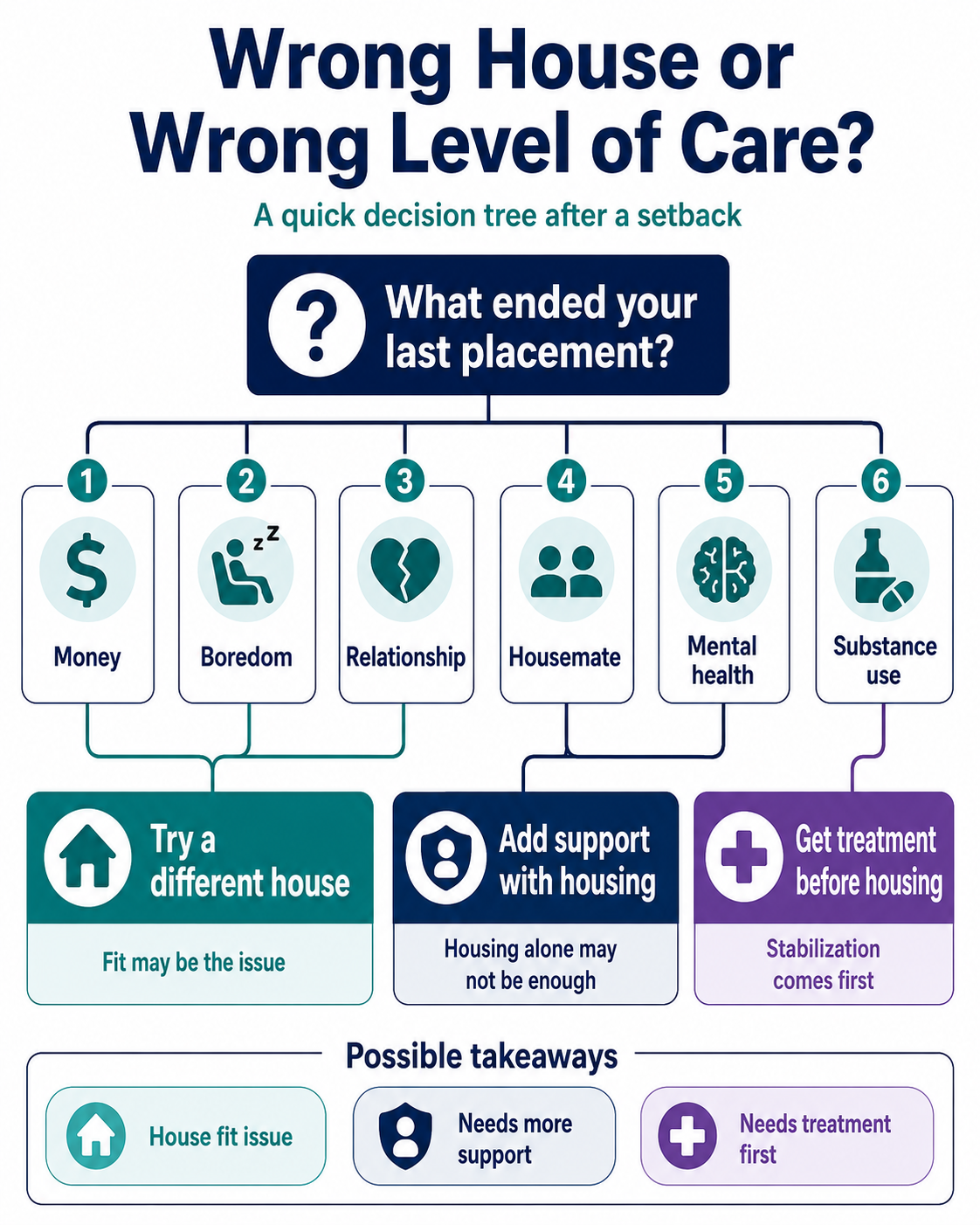
Was the Sober Living Home the Problem, or Do You Need Different Support?
Sometimes a living environment is not a good match. In other situations, changing houses may not address the main reason the previous stay ended.
Distinguishing between those situations is important before moving again.
When a Different Sober Living Home May Be a Better Fit
A different home may be useful when the main problems were connected to the living arrangement itself.
For example, you may want to reconsider:
- Location and transportation
- Compatibility with work hours
- House expectations
- Roommate arrangements
- Cost
- Community and accountability
- How much routine is built into everyday living
These are questions you can investigate before admission rather than discovering the answers after moving in.
When You May Need Support Beyond Sober Living
Sometimes the difficulty extends beyond the house itself.
If mental health concerns, repeated substance use, medication needs, or other challenges are making it difficult to live safely and consistently in sober living, changing addresses alone may not be enough.
Some men may benefit from professional support alongside housing. Others may need a different setting before sober living is appropriate. If mental health and substance use concerns are occurring together, learning more about dual diagnosis can help you understand why both may need attention.
A qualified healthcare professional can help you determine what level of support is appropriate. A sober living home should not be expected to provide services beyond its role as a residential environment.
Can You Be Accepted Into Sober Living After a Previous Discharge?
A previous discharge does not create one universal rule about whether another sober living home will admit you.
Admission policies differ between residences. A home may ask about previous sober living experiences, why a stay ended, and what has changed since then.
If you are wondering, “Will a sober living take me back?”, ask the individual residence rather than assuming that one or several previous discharges automatically determine the answer.
How Should You Discuss Previous Discharges During Admission?
You do not need to turn the conversation into a defense of everything that happened.
Be straightforward about:
- Why the previous stay ended
- Your part in what happened
- Any circumstances that contributed
- What you have changed since then
- What you plan to do differently this time
Avoid assuming that every home will contact previous residences or request the same information. If you want to know whether prior homes are contacted, ask during admission.
The goal is to give an accurate picture of your situation so both you and the residence can decide whether the home is appropriate for your next step.
What if You Still Owe Money to a Previous Sober Living Home?
An unpaid balance with a previous home is another issue to clarify rather than hide or make assumptions about.
Start by confirming how much you owe and whether you have an agreement for repayment. Keep records of any payments or communication with the previous residence.
Whether an outstanding balance affects admission to another sober living home depends on that home's policies. Ask directly rather than assuming that a previous debt automatically prevents you from moving somewhere else.
What Needs to Be Different Before You Move Into Another Home?
Once you understand what contributed to the last stay ending, connect the problem to an actual change.
Simply choosing another sober house may not be enough if everything surrounding the move remains the same.
If Money Was the Problem
Calculate the cost of housing alongside your reliable monthly income before committing to another home.
Include transportation, food, phone expenses, debts, and other regular obligations. If the numbers do not work, address that before moving rather than depending on income you do not yet have.
If Work or Your Schedule Became Difficult to Manage
Compare your work hours and commute with the home's expectations before admission.
Ask about schedules, meetings, responsibilities, and any other commitments that could affect your job. If your work situation changes frequently, discuss that as well.
If Conflict With a Housemate or Relationship Contributed
Consider what happened before focusing only on the other person's behavior.
You may need clearer boundaries, a different roommate environment, or a plan for dealing with conflict before it reaches the point where your housing is affected.
If Boredom or Lack of Routine Became a Problem
Look at what your day will contain outside the home.
Work, meetings, exercise, appointments, community responsibilities, and other planned activities can reduce long stretches of unplanned time. The goal is not to keep every minute occupied, but to have a routine you can realistically maintain.
If Mental Health or Substance Use Made Staying Difficult
Be careful about treating this as a problem that a different house will automatically solve.
If the same concern has contributed to more than one stay ending, consider discussing it with an appropriate healthcare professional before choosing the next home. You may need additional support alongside sober living or before returning to it.
How Can You Prepare Differently for Your Next Sober Living Home?
The period between one housing situation ending and another beginning can move quickly. Taking some time to ask specific questions can prevent you from choosing solely because a bed is available.
Before your next move:
- Identify why the previous stay ended. Be specific about the circumstances.
- Decide what needs to change. Connect each problem with an action rather than a promise.
- Compare house expectations. Ask about rules, schedules, costs, work, transportation, and roommates.
- Be clear about the support you need. Determine whether sober living alone is appropriate for your current situation.
- Plan beyond move-in. Think about employment, finances, community, and what will eventually come after sober living.
It can also help to think beyond the first few weeks. A step-down plan can help you consider what needs to be in place before moving toward a more independent living arrangement.
Preparation does not guarantee that everything will go smoothly. It does give you more information to work with than simply starting over in another house.
Start Your Next Sober Living Stay With a Clearer Plan
Starting sober living for a second or third time does not require pretending the previous experiences did not happen. Those experiences can provide useful information about the environment, routines, relationships, and support you need to reconsider.
At Design for Recovery, we provide men's sober living in Los Angeles with a substance-free environment, peer community, and accountability. If you are considering another sober living stay, the focus can be on understanding where things became difficult before and what needs to change this time.
When you are ready to consider your next move, you can learn how admission works or ask us directly about our homes and current availability.
- Start With What Happened During Your Last Sober Living Stay
- Was the Sober Living Home the Problem, or Do You Need Different Support?
- Can You Be Accepted Into Sober Living After a Previous Discharge?
- What Needs to Be Different Before You Move Into Another Home?
- How Can You Prepare Differently for Your Next Sober Living Home?
Begin Lasting Sobriety Now!



Frequently Asked Questions
There is no universal waiting period that applies to every sober living home after a discharge. Timing can depend on the new home's admission policies, current availability, and your circumstances. Before moving immediately, consider whether anything needs to change to prevent the same problem from following you into the next home.
Sometimes. A different home may help when location, cost, house expectations, scheduling, or the living environment contributed to the previous stay ending. If the main difficulty was unrelated to the home, however, changing residences alone may not address it.
Some people enter sober living more than once, but there is no reliable number that determines how many attempts someone should need. What is more useful is understanding why the previous stay ended and whether your needs are different now. Avoid treating another stay as an exact repeat of the previous one.
Look beyond whether a bed is immediately available. Compare costs, house expectations, location, transportation, roommates, community, and compatibility with your work schedule. Ask questions about the parts of your previous experience that caused the most difficulty.
You may need to consider other housing options rather than relying on returning to a family home. Try to separate the immediate need for somewhere to live from decisions about repairing family relationships. If sober living remains appropriate for you, ask about availability while also considering what support and financial plan you need for the next move.
There is no single length of stay that is appropriate for everyone. Consider your progress, finances, employment, support network, and whether you have a stable next housing option. Planning the transition before you leave can be more useful than choosing an arbitrary date.
- seanmu92. (2019, August 12). Just got kicked out of my halfway house [Online forum post]. Reddit. https://www.reddit.com/r/REDDITORSINRECOVERY/comments/cpkfeb/just_got_kicked_out_of_my_halfway_house/



Written By
David Beasley