(424) 242-1130
Sober living may become part of the picture when someone is dealing with probation, diversion, or another court-related requirement. This can raise important questions about what the court expects, what a sober living home can provide, and what someone may need to document.
Sober living does not guarantee a particular legal outcome or automatically satisfy a court requirement. Its role depends on the individual case, the conditions that apply, and what the court or supervising officer requires.
When Sober Living Is Part of a Court or Supervision Requirement
People enter sober living under different circumstances. Some make the decision themselves while a legal matter is pending. Others may have housing, participation, or other requirements connected to probation or a court-supervised program.
The distinction is important because court-ordered sober living, sober living entered voluntarily, and court-ordered rehab in California do not necessarily mean the same thing.
Entering Sober Living Voluntarily
Someone may move into a sober living home before sentencing, while a case is pending, or while already on probation.
California's probation criteria include a person's willingness and ability to comply with reasonable probation terms. The court's advisory comments also state that a supportive home and work environment can be considered when evaluating the likelihood of successful compliance.
That does not mean entering sober living voluntarily guarantees a more favorable sentence. A judge considers the circumstances of the case as a whole.
For someone who is already facing legal proceedings, an attorney can explain whether a voluntary move into sober living is relevant to their particular case.
When Sober Living Is Required
A court order or supervision plan may include specific requirements around residence, participation in programs, testing, or other recovery activities. Those requirements should be read carefully rather than interpreted broadly.
A judge-ordered sober living arrangement should also be distinguished from residential or outpatient programs. Sober living provides a substance-free living environment but is not automatically a clinical program.
If an order refers specifically to a program, a sober living home should not be assumed to meet that requirement. The attorney, probation officer, court, or other appropriate authority can clarify what type of placement is required.
What Your Court or Probation Officer May Need From You
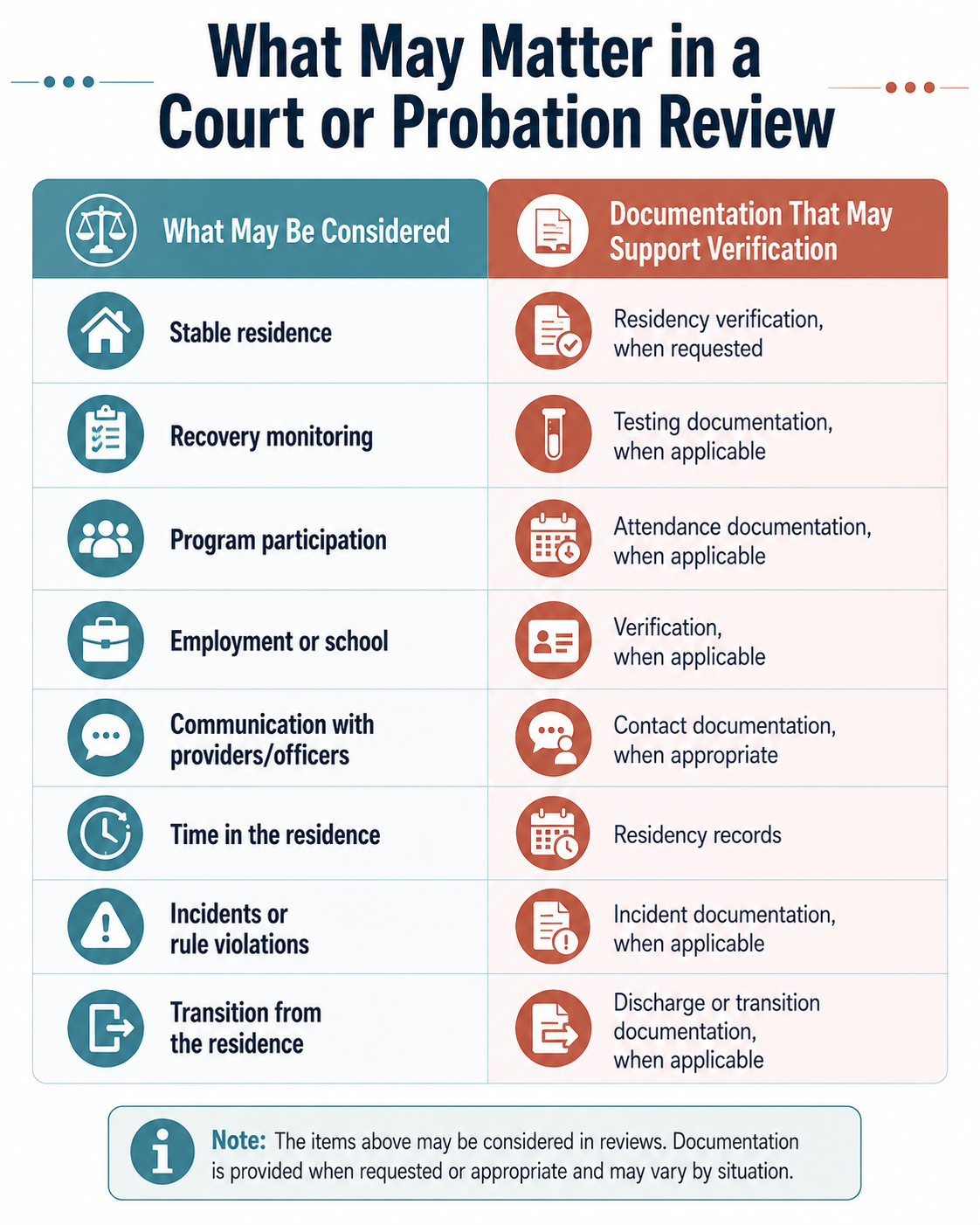
Documentation can become important when someone's housing is connected to probation or another court requirement. There is no single list of records that applies to every case, so the actual court order and supervision conditions should come first.
Depending on those requirements, information that may need verification can include:
- Current residence: confirmation of where the person is living.
- Attendance: records when attendance at particular activities is required.
- Testing: results or verification when drug or alcohol testing is part of the order.
- Program participation: confirmation of participation in a required program.
- Compliance: documentation connected to specific supervision conditions.
- Address changes: updated information when a change of residence must be reported.
The keyword is required. Someone should not collect paperwork simply because it might appear helpful. The court, attorney, or probation officer can clarify what documentation is actually needed.
Compliance Letters and Other Records
A compliance letter may be used to verify information about someone's participation or residence when the organization maintains those records and is able to provide them.
The exact information available differs between men's sober living homes. Before relying on a residence for court documentation, confirm what the home records, what it can verify, and whether that documentation meets the requirements you have been given.
Records should also reflect what actually occurred. A residence should not be expected to change someone's history or provide information it cannot verify.
Working With Your Probation Officer
Sober living for probation can involve more than simply providing an address. The person on probation needs to understand the conditions that apply to them and what information their probation officer expects.
A sober living home should not automatically be assumed to communicate every detail of a resident's stay to probation. Reporting practices, legal obligations, supervision conditions, and individual residence policies can differ.
Before moving in, useful questions include:
- Does my probation officer need to know where I am living?
- Does the residence need approval?
- What documentation will I need to provide?
- Does anyone need to verify my attendance or participation?
- Who should I contact before changing residences?
Probation and parole should not be used interchangeably either. Both involve community supervision, but they arise in different legal circumstances and can carry different requirements.
The safest approach is straightforward: follow the conditions that actually apply to your case and clarify anything that is unclear with your attorney or supervising officer.
Does Your Court Program Require Sober Living?
Drug court, diversion, and PC 1000 may come up when researching court-related options in California. These are different legal processes, and sober living should not automatically be assumed to be part of each one.
A simple distinction can help:
- Drug court: California's adult drug courts combine judicial oversight and monitoring with supervision and other services. Programs can operate differently between jurisdictions.
- Diversion: a legal process that can provide an alternative path through a criminal case for eligible individuals.
- PC 1000: California Penal Code §1000 provides for pretrial diversion in certain eligible drug-related cases. It is not a type of sober living home.
California's Judicial Branch notes that collaborative court programs can differ in their eligibility criteria, requirements, length, supervision, services, and graduation criteria.
For that reason, living in a sober home should not automatically be assumed to fulfill the requirements of drug court, diversion, PC 1000, or another court program. The requirements of the person's individual case should be confirmed with their attorney, court, or supervising authority.
When Your Circumstances Change
Probation does not always proceed exactly as expected. A missed requirement, change in residence, or return to substance use can raise questions about what happens next.
There is no single answer that applies to every case. The person's probation conditions, the circumstances involved, applicable law, previous compliance, and the court's decisions can all be relevant.
If You Violated a Probation Condition
A concern during probation can raise questions about what happens next. Moving into sober living does not automatically resolve the issue or determine the court's response.
California courts consider multiple factors when evaluating probation, including a person's prior performance on probation or parole and willingness and ability to comply with probation terms.
For someone facing a possible issue, a few details may be important to clarify:
- Which probation condition is involved?
- Does the probation officer need to be contacted?
- Is any documentation required?
- Does a change in residence need to be reported?
- Should an attorney be contacted before taking another step?
A sober living provider can explain its own policies, but questions about the legal consequences of a possible probation issue belong with an attorney.
If You Return to Alcohol or Drug Use
A return to alcohol or drug use while on probation does not have one universal legal consequence.
The response depends on the person's supervision conditions, court program, circumstances, and applicable law. Some court-supervised programs also have their own procedures for addressing noncompliance.
The important point for someone entering sober living is to understand their own reporting and supervision requirements before a problem occurs.
How Long Do You Have to Stay in Sober Living?
There is no universal length of time someone must remain in court-ordered sober living.
A person's sober living stay may be affected by the terms of a court order, probation conditions, the requirements of a particular program, and the policies of the residence itself. The duration of probation or a court program also does not automatically determine the length of the sober living stay.
If the residence is connected to a legal requirement, confirm what must happen before moving out or changing homes. A decision that seems straightforward from a housing perspective could have different implications when supervision conditions are involved.
A Stable Home While You Move Forward
Design for Recovery provides men's sober living in Los Angeles with a focus on accountability, community, and everyday routines. If you're considering sober living while dealing with court or probation requirements, your attorney or supervising authority can clarify what your particular case requires.
- When Sober Living Is Part of a Court or Supervision Requirement
- What Your Court or Probation Officer May Need From You
- Working With Your Probation Officer
- Does Your Court Program Require Sober Living?
- When Your Circumstances Change
- How Long Do You Have to Stay in Sober Living?
- Before You Move Into Court-Related Sober Living
- Sober Living Resources
Begin Lasting Sobriety Now!



Frequently Asked Questions About Men's Sober Living in Los Angeles
A judge may impose conditions relevant to a person's residence or participation in court-supervised programs when permitted by law. Whether sober living is specifically required depends on the case and court order.
No sober living home can guarantee that someone will avoid jail or prison. Courts make those decisions based on applicable law and the circumstances of the case. California's probation rules identify numerous factors courts may consider, and no single factor ordinarily determines the decision.
Yes, it may be possible to live in sober living while on probation. The important question is whether the residence and living arrangement meet any conditions that apply to your particular supervision.
No. Sober living generally provides a substance-free residential environment, while rehab typically refers to a treatment program. If a court order requires treatment, do not assume sober living alone satisfies that requirement.
That depends on the person's probation conditions and supervision requirements. Check with the probation officer or attorney before moving when residence approval may be required.
There is no single duration that applies to every case. The court order, probation conditions, applicable program, and residence policies may all affect the length of stay.
- Judicial Branch of California. (n.d.). Rule 4.414. Criteria affecting probation. California Courts. https://courts.ca.gov/cms/rules/index/four/rule4_414
- Judicial Branch of California. (n.d.). Drug courts. California Courts. https://courts.ca.gov/programs-initiatives/collaborative-justice-courts/adult-courts/drug-courts
- California Legislative Information. (n.d.). California Penal Code § 1000. California State Legislature. https://leginfo.legislature.ca.gov/faces/codes_displaySection.xhtml?lawCode=PEN§ionNum=1000.