(424) 242-1130
Many sober living homes are designed for either men or women. If you are comparing housing options, you may wonder why gender is considered when the main goal is to live in a substance-free environment and build a stable recovery routine.
Questions from people considering or living in sober housing show that the reasons for separating homes by gender are not always obvious, especially when concerns about relationships and safety come into the picture.
Reddit User Asks
“Why do they separate the people in sober living/rehab by sex/gender?”
“I was offered a chance to go to a sober living environment with 16 other recovering addicts instead of doing jail time. The house next door has females. My question is — is this safe? No one at either of our houses knows.”
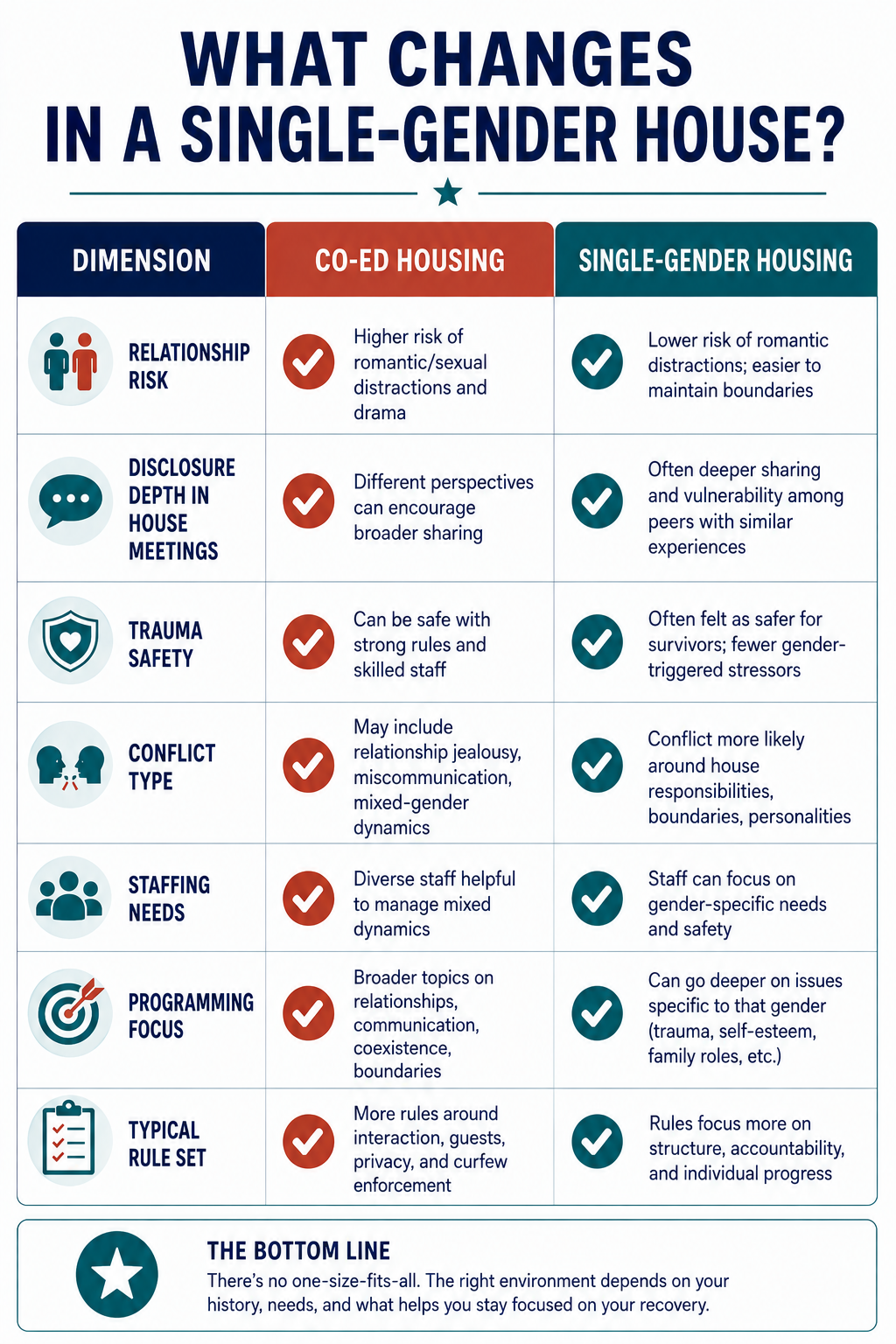
Gender-separated housing is one approach used in recovery housing. It can create a peer environment centered on shared responsibilities, recovery, and community while reducing some of the relationship dynamics that can develop in mixed-gender living.
That does not mean co-ed sober living is automatically a poor choice. Different environments can work for different people. Looking at relationships, boundaries, privacy, peer dynamics, and personal comfort can help you decide which type of home may suit you.
Why Are Some Sober Living Homes Separated by Gender?
Single-gender recovery housing is designed around more than simply keeping men and women in different buildings. Gender-specific sober living can create an environment centered on peer connection, shared responsibilities, personal boundaries, and the needs of the residents a home serves.
Research on sober living homes has included both single-gender and co-ed residences. One California study found that residents recruited from men's houses had higher adjusted odds of alcohol abstinence than those recruited from co-ed houses. However, the findings do not establish that one housing model is better for everyone.
For residents, however, the more immediate question is usually what a single-gender environment may change in everyday life.
How Can a Single-Gender Environment Help?
Living with other people in recovery means sharing space, responsibilities, disagreements, and personal experiences. A single-gender home may make some residents more comfortable discussing experiences they find difficult to bring up in a mixed-gender environment.
It may also reduce some of the potential complications that can develop when residents begin dating one another. This can leave more room to focus on:
- Building relationships with peers
- Following household expectations
- Developing everyday routines
- Managing work and other responsibilities
- Participating in a recovery community
- Learning to address conflict directly
These potential benefits are not guarantees. Gender separation alone does not create a healthy living environment. House culture, boundaries, accountability, and relationships among residents still play an important role.
Why Might Trauma Affect Someone’s Preference for Single-Gender Housing?
Some people entering sober living have experienced abuse, violence, or other forms of trauma. Those experiences can influence how comfortable someone feels sharing bedrooms, bathrooms, common spaces, or personal experiences with other residents.
For some men, living with other men may make it easier to settle into the home and develop peer connections. For others, gender alone may have little influence on how comfortable they feel.
A trauma-informed environment therefore involves more than separating residents by gender. Personal boundaries, respectful communication, predictable expectations, and the way concerns are handled within the home can also shape someone's experience.
What Can Be Different in a Men’s Sober Living Home?
A men’s sober living home creates a community where residents share not only recovery goals but also some experiences associated with navigating life as men.
That does not mean every resident will think, communicate, or respond in the same way. A men's home still includes different personalities, backgrounds, ages, relationships, and life experiences.
Peer Connection and Open Conversation
Some men may find it easier to discuss certain subjects with other men who are dealing with similar challenges.
Those conversations might involve:
- Family and fatherhood
- Dating and relationships
- Work and financial responsibilities
- Anger and conflict
- Asking other people for help
- Rebuilding trust
- Expectations around masculinity
The goal is not to assume that men can only discuss these subjects with other men. Rather, a men's sober living environment can create another setting where those conversations have room to develop naturally.
Shared Routines and Responsibilities
Much of sober living happens outside formal conversations. Residents share kitchens and common areas, complete household responsibilities, manage work schedules, attend meetings, and deal with ordinary disagreements.
Doing those things alongside other men can create opportunities to practice:
- Following through on commitments
- Communicating when something is wrong
- Accepting feedback
- Resolving disagreements
- Asking for support
- Supporting another resident without taking responsibility for his recovery
Over time, these everyday interactions can help residents learn how to participate in a community rather than approaching sober living only as a place to sleep.
When Can Co-Ed Sober Living Work Well?
Co-ed sober living can provide a supportive environment for people who feel comfortable living with residents of different genders. Some may also prefer a household that more closely resembles other shared living environments they will encounter outside sober living.
Depending on the person and the home, co-ed housing may offer opportunities to build healthy friendships across genders, practice personal boundaries, and learn from a broader range of peer perspectives.
The important question is not whether co-ed or single-gender housing is universally better. House culture, accountability, privacy, and clear expectations can have a greater influence on what daily life actually feels like.
What Should You Ask Before Choosing a Co-Ed Home?
Before choosing a home, find out how bedrooms, bathrooms, and shared spaces are arranged and what privacy expectations residents are expected to follow. You should also understand the home's policies around dating and relationships between residents.
Ask how boundary concerns or conflicts are handled and who you can speak with if a problem develops. These details give you a clearer picture of the environment than the label “co-ed” by itself.
Can Couples Live Together in Co-Ed Sober Living?
Co-ed housing does not necessarily mean that couples can live together. A residence may house men and women while still having policies that prevent couples from living in the same home.
If you and your partner are both considering sober living, ask each residence about its relationship and housing policies before making plans. Do not assume that choosing a co-ed residence automatically means you can move in together.
Separate homes may give each person space to establish an individual routine, develop peer relationships, and build a support network while continuing the relationship outside the residence. Whether that arrangement is appropriate depends on the couple's circumstances and the policies of the homes they are considering.
How Does Gender Identity Affect Sober Living Placement?
Gender identity adds considerations that cannot be answered simply by describing a home as men's, women's, or co-ed housing.
For transgender and nonbinary people considering sober living, understanding how a residence approaches placement can help clarify what to expect before moving in. Policies can differ, so it is better to ask directly rather than assume how a particular home will make that decision.
How Are Placement Decisions Made?
A residence should be able to explain its approach clearly. Depending on the program, placement considerations may include the type of housing offered, the population the home serves, privacy arrangements, and the individual's circumstances.
What Should You Ask Before Moving In?
If gender identity may affect placement, useful questions include:
- Which home would I be considered for?
- How are bedrooms and bathrooms arranged?
- How is privacy handled?
- Who can I speak with about placement concerns?
- What happens if concerns arise after I move in?
Getting these answers beforehand can make expectations clearer and help you evaluate whether you feel comfortable with the environment.
What Is Men’s Sober Living Like at Design for Recovery?
Design for Recovery provides sober living for men in Los Angeles. Our approach centers on peer community, accountability, everyday responsibilities, and developing habits that can support life beyond the house.
Residents live alongside other men who are also working on their recovery. Shared responsibilities, community involvement, employment, meetings, and peer relationships can all become parts of everyday life.
Our mission reflects the belief that lasting change develops through responsibility, connection, and participation in a community. A men-only model is part of how we create that environment at Design for Recovery.
It is one approach to sober living, rather than a claim that every person should choose single-gender housing.
Find the Sober Living Environment That Works for You
Gender is one consideration when choosing a sober living home. House culture, relationships between residents, expectations, location, accountability, privacy, and how comfortable you feel in the environment can be just as important.
Single-gender and co-ed sober living offer different shared-living experiences. Asking how a home approaches relationships, boundaries, conflict, privacy, and placement can help you understand what everyday life there may actually be like.
If you are considering men's sober living in Los Angeles, Design for Recovery provides a community where men can build routines, accountability, and supportive peer connections as they move forward.
- Why Are Some Sober Living Homes Separated by Gender?
- How Can Dating and Relationships Affect Shared Sober Living?
- Why Might Trauma Affect Someone’s Preference for Single-Gender Housing?
- What Can Be Different in a Men’s Sober Living Home?
- When Can Co-Ed Sober Living Work Well?
- Can Couples Live Together in Co-Ed Sober Living?
- How Does Gender Identity Affect Sober Living Placement?
- What Is Men’s Sober Living Like at Design for Recovery?
Begin Lasting Sobriety Now!



Frequently Asked Questions About Men's Sober Living in Los Angeles
Not necessarily. A home being designated for male residents does not automatically mean every staff member will be a man. If staff composition is important to you, ask the individual residence who works in the home and when staff members are present.
Possibly. A single-gender residence may still allow visits from family members or other approved guests. Visitor policies differ, so ask about visiting hours, approved areas, overnight guests, and any other expectations before planning a visit.
Yes, they can be. Some homes offer shared rooms, while arrangements differ between residences. Ask about the number of people in a room, storage, bathrooms, and privacy before moving in.
Yes, potentially. Someone may decide that a men's environment better suits what they are looking for after spending time in co-ed housing. Admission will still depend on the requirements and availability of the new residence.
Not automatically. Living in a men's sober living home and having a dating policy are separate issues. Some residences place boundaries around dating or new relationships, particularly during certain stages of a resident's stay. Ask about the home's policy so you know what is expected.
Families can ask about more than whether the home houses men or women. It may be helpful to ask about house culture, peer relationships, personal boundaries, privacy, shared spaces and more.
- Mericle, A. A., Mahoney, E., Korcha, R., Delucchi, K., & Polcin, D. L. (2019). Sober living house characteristics: A multilevel analyses of factors associated with improved outcomes. Journal of Substance Abuse Treatment, 98, 28–38. https://pmc.ncbi.nlm.nih.gov/articles/PMC6605057/
- Why do they separate the people in sober living/rehab by sex/gender? (2021, March 17). [Online forum post]. Reddit, r/Methadone. https://www.reddit.com/r/Methadone/comments/m700hf/why_do_they_separate_the_people_in_sober/
- 13th stepping in halfway house (2024, June 3). [Online forum post]. Reddit, r/alcoholicsanonymous. https://www.reddit.com/r/alcoholicsanonymous/comments/1d7mjo5/13th_stepping_in_halfway_house/