 (424) 242-1130
A craving can arrive suddenly, making it difficult to focus on anything other than drinking or using a substance.
In recovery, even a passing thought can feel intense, especially when stress, familiar routines, or difficult emotions bring old habits to mind.
Urge surfing is a mindfulness technique that can help you respond to a craving without automatically acting on it. Instead of trying to force the feeling away, you learn to notice it and decide what to do next.
The goal is not to eliminate every craving or expect recovery to feel easy. It is to build a little more space between the urge and your response, one moment at a time.
What Is Urge Surfing?
Urge surfing is a coping technique used in relapse prevention that involves noticing a craving without judging it, fighting it, or immediately giving in to it.
The approach is associated with psychologist G. Alan Marlatt's work on mindfulness and addictive behaviours.
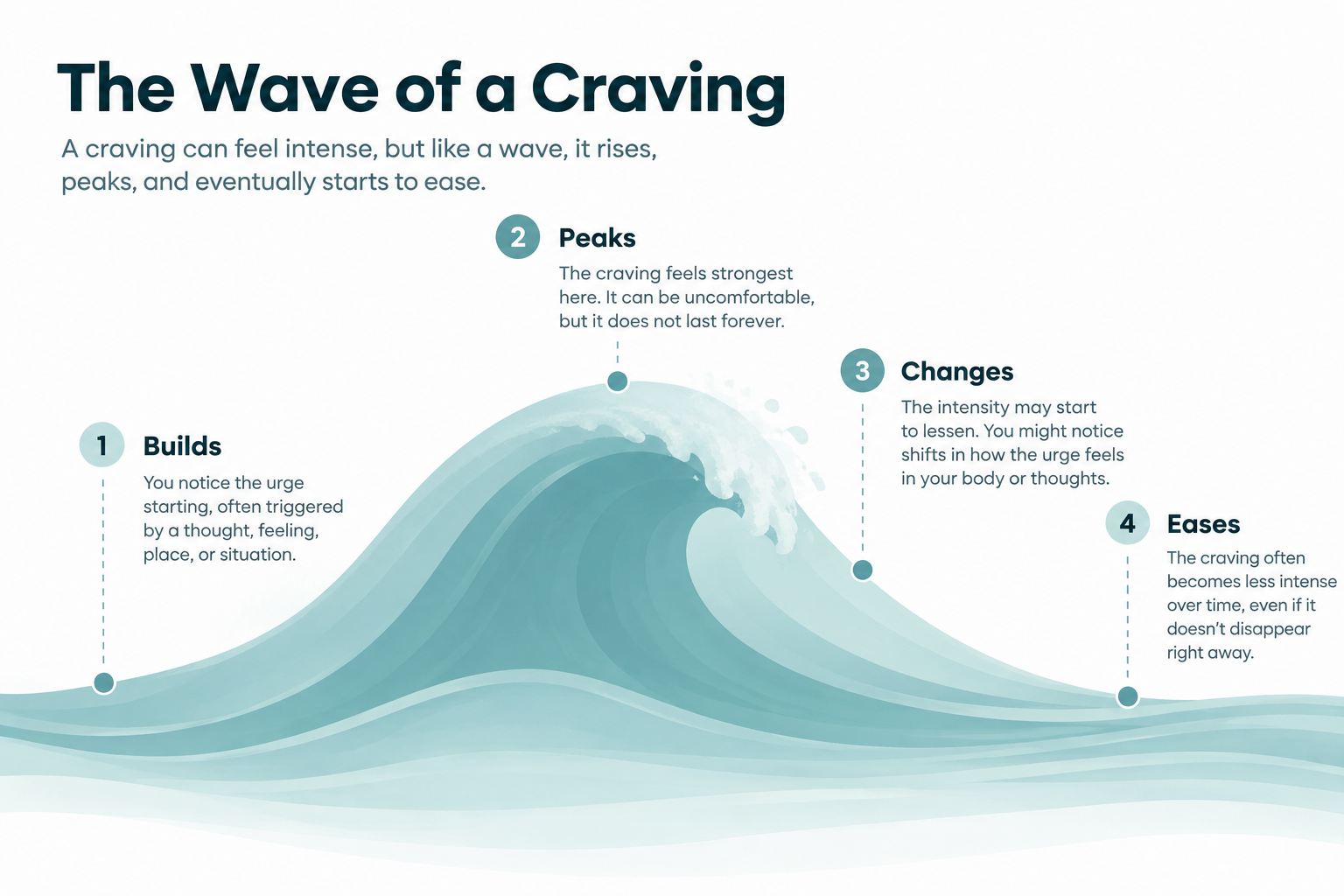
The name comes from the way a wave moves through the ocean. It builds, reaches a peak, and changes over time.
A craving can feel similar: it may become more noticeable, fluctuate in intensity, and eventually ease. The experience is not always predictable, but the feeling does not have to dictate your next action.
Urge surfing also changes how you interpret a craving. Rather than thinking, I need to use right now, you can recognise, I am experiencing an urge to use. That distinction helps you view the craving as an experience you are having, rather than an instruction you must follow.
Research offers some support for mindfulness-based approaches to cravings, although the evidence for urge surfing as a standalone technique is still limited.
How to Practise the Urge Surfing Technique
You can practise urge surfing when a craving appears, ideally somewhere you feel safe and can pause without immediate pressure.
You do not need to make the feeling disappear. Focus on observing what is happening and deciding how to respond.
Step 1: Acknowledge the craving
Name what you are experiencing without criticising yourself. You might say, I am having a craving for alcohol, or I am noticing an urge to use. Recognising the feeling can help you pause instead of responding automatically.
Step 2: Notice what is happening in your body
Bring your attention to the physical sensations accompanying the urge. You might notice tension in your shoulders, restlessness, a tight feeling in your chest, or a sense of agitation. Try to describe the sensations rather than immediately labelling them as good or bad.
Step 3: Observe your thoughts without following them
Notice what your mind is telling you. You may think that using will help you relax, make a difficult situation easier, or stop the discomfort. You do not need to argue with every thought or treat it as a fact. Simply recognise that the thought is present.
Step 4: Pay attention to changes
Notice whether the craving feels stronger, weaker, or different as you sit with it. If your attention wanders, gently bring it back to your breathing or the sensations you are experiencing. There is no need to force yourself to remain perfectly calm.
Step 5: Choose your next action
Once you have paused to observe the urge, decide what would help you protect your recovery. You might contact a trusted support person, move away from a trigger, or return to an activity that matters to you.
If the craving remains intense, you can seek support rather than trying to manage it alone.
Remember: urge surfing is a skill to practise, not a test of willpower. If you find it difficult at first, that does not mean you have failed. You can use it alongside other coping strategies and support from people who understand recovery.
How Long Do Cravings Actually Last?
You may have heard that a craving lasts about 20 minutes. This is a commonly repeated guideline, but it should not be treated as a scientifically established time limit for every craving.
Cravings vary from person to person and can differ depending on the substance, the situation, and what is contributing to the urge. Some may ease relatively quickly, while others can return repeatedly or remain difficult to manage. A craving that lasts longer than 20 minutes does not mean the technique has failed.
The research on urge surfing also does not establish a universal countdown. They discuss how mindfulness can help people relate differently to cravings, but it does not establish that every craving peaks or disappears within a fixed period.
A practical approach is to focus on what happens to your craving rather than watching the clock for a guaranteed endpoint.
Urge Surfing Worksheet: Track Your Cravings
An urge surfing worksheet can help you recognise patterns in your cravings over time. Instead of relying on memory, you can record what happened before an urge, how you experienced it, and what helped you respond.
Use the template below after a craving has passed or when you feel comfortable writing. You do not need to complete every field during an intense moment.
| What to Record | Questions to Consider |
| Situation or trigger | What was happening before the craving started? |
| Emotion | Was I feeling stressed, lonely, frustrated, bored, or something else? |
| Craving intensity | How strong was the urge from 0 to 10? |
| Physical sensations | What did I notice in my body? |
| Thoughts | What was I telling myself about using? |
| My response | What did I do instead of acting automatically? |
| What changed | Did the craving become stronger, weaker, or stay about the same? |
| What helped | Was there a person, activity, or coping strategy that made the situation easier to handle? |
Your experience may look different. The purpose is not to produce a perfect record or prove that every craving gets weaker. It is to learn which situations tend to affect you and which responses support your recovery.
Note: The worksheet is a reflection tool, not a substitute for professional care when cravings feel unmanageable.
What If Urge Surfing Doesn't Help?
Urge surfing is one way to respond to cravings, but it will not work the same way for everyone or in every situation.
You may still feel uncomfortable after practising, or the urge may return later. That does not mean you have failed.
If the craving remains strong, consider what you need in that moment rather than relying on one technique.
- If you feel overwhelmed, contact someone you trust instead of managing the craving alone.
- If your surroundings are making the urge harder to manage, move away from people, places, or situations connected to substance use, if it is safe to do so.
- If you are caught in repetitive thoughts, try a grounding activity or a simple task that brings your attention back to the present.
- If cravings keep recurring, discuss them with an addiction professional who can help you develop a broader relapse-prevention plan.
If you have been drinking heavily or using certain substances regularly, seek medical advice before stopping suddenly, as withdrawal can sometimes be dangerous.
When You Need More Support With Cravings
Cravings can be part of recovery, but you do not have to manage them alone.
If they are frequent, disruptive, or making it difficult to maintain your recovery goals, it may help to build a stronger support system.
Different types of support can serve different needs:
- Addiction treatment or counselling: A qualified professional can help you understand your triggers, address underlying concerns, and develop a plan for managing cravings.
- Peer recovery groups: Groups such as Alcoholics Anonymous (AA), Narcotics Anonymous (NA), or SMART Recovery can offer connection, shared experience, and ongoing accountability.
- Structured sober living: A recovery-focused home can provide a substance-free environment, house expectations, peer connection, and routines that support daily recovery. It is not a substitute for detox or clinical treatment.
The right combination depends on your circumstances, your support network, and the level of care you need.
Building Support Beyond the Craving
Learning to respond differently to cravings can be one part of recovery.
Consistent routines, supportive relationships, accountability, and access to appropriate care also matter.
At Design for Recovery, our men's sober living homes in Los Angeles provide a structured, substance-free environment where residents can build routines, connect with peers, and work towards greater independence.
- What Is Urge Surfing?
- How to Practise the Urge Surfing Technique
- How Long Do Cravings Actually Last?
- Urge Surfing Worksheet: Track Your Cravings
- What If Urge Surfing Doesn't Help?
- When You Need More Support With Cravings
Begin Lasting Sobriety Now!


Frequently Asked Questions
In dialectical behavior therapy (DBT), urge surfing is used as a distress-tolerance skill. It involves noticing an urge without automatically acting on it, helping you make a more considered response to uncomfortable feelings or impulses.
It may help you change how you respond to cravings by increasing awareness of your thoughts, feelings, and physical sensations. However, it is not a guaranteed way to reduce cravings, and it should be used alongside appropriate recovery support when needed.
The underlying practice of observing thoughts and sensations without immediately reacting to them may be useful in some anxiety-management approaches. However, persistent or severe anxiety may require a more tailored approach with a qualified mental health professional.
No. Suppression involves trying to push away or avoid an unwanted thought or feeling. Urge surfing encourages you to acknowledge the experience without automatically acting on it. You can recognise a craving without giving it control over your behaviour.
You can practise using a worksheet or guided script. If cravings are intense, frequent, or connected to a risk of relapse, professional guidance can help you determine which coping strategies and level of support are appropriate.
- Bowen, S., & Marlatt, A. (2009). Surfing the urge: Brief mindfulness-based intervention for college student smokers. Psychology of Addictive Behaviors, 23(4), 666–671. https://pubmed.ncbi.nlm.nih.gov/20025372/
- Goldberg, S. B., Pace, B., Griskaitis, M., Willutzki, R., Skoetz, N., Thoenes, S., Zgierska, A. E., & Rösner, S. (2021). Mindfulness-based interventions for substance use disorders. Cochrane Database of Systematic Reviews, 2021(10), Article CD011723. https://pmc.ncbi.nlm.nih.gov/articles/PMC8527365/



Written By
David Beasley