(424) 242-1130
Reddit User Asks
“they want me to get a letter signed by my boss, saying that I work for him. I feel like that is bullsh!t and should not have to do it. I am not on parole, you know. Why should I have to tell my boss I live in a sober house? I do not feel like that is info I should have to share with my boss.”
— r/Sober
Starting sober living often means getting your everyday life back into a steady routine. That can include working, paying rent, attending recovery meetings, managing appointments, and taking responsibility for your schedule.
For many sober living programs, employment is part of that routine. But proving that you have a job should not automatically mean telling your employer where you live or why you live there.
The concern raised above gets to the heart of the issue: a sober living residence may need reasonable evidence that you are employed and able to meet your financial responsibilities, but that does not necessarily mean your boss needs to know that you live in sober living.
This guide explains common ways to provide sober living proof of employment, what may count as verification, and how to protect your privacy during the process.
That concern is understandable. A sober living residence may need reasonable evidence that you are employed and able to meet your financial responsibilities. That does not necessarily mean your boss needs to know that you live in a sober living home.
This guide explains common ways to provide sober living proof of employment, what may count as verification, and how to protect your privacy during the process.
Why Houses Verify Employment
Employment verification serves a practical purpose in sober living.
A house needs to know that residents can meet their financial responsibilities, including rent and other everyday expenses. Having a job can also give a resident a regular schedule, responsibilities outside the home, and a reason to maintain consistent daily habits.
Work is not the only meaningful activity someone can have in recovery. People may also be attending school, volunteering, caring for family members, or developing other responsibilities.
The specific sober living job requirement depends on the program. Some programs may require employment from the beginning, while others may provide a set amount of time for residents to find work.
The important thing is knowing exactly what the house expects before you move in.
Do You Have to Tell Your Employer You Live in Sober Living?
There is an important difference between being required by a sober living program to verify employment and being legally required to disclose your living situation to your employer.
A sober living program may establish its own eligibility and participation requirements. But that does not mean every employment verification process requires your employer to know that you live in recovery housing.
The practical point is simple: do not assume that an employer letter is the only possible way to prove that you work.
Verification Methods That Do Not Involve Your Employer
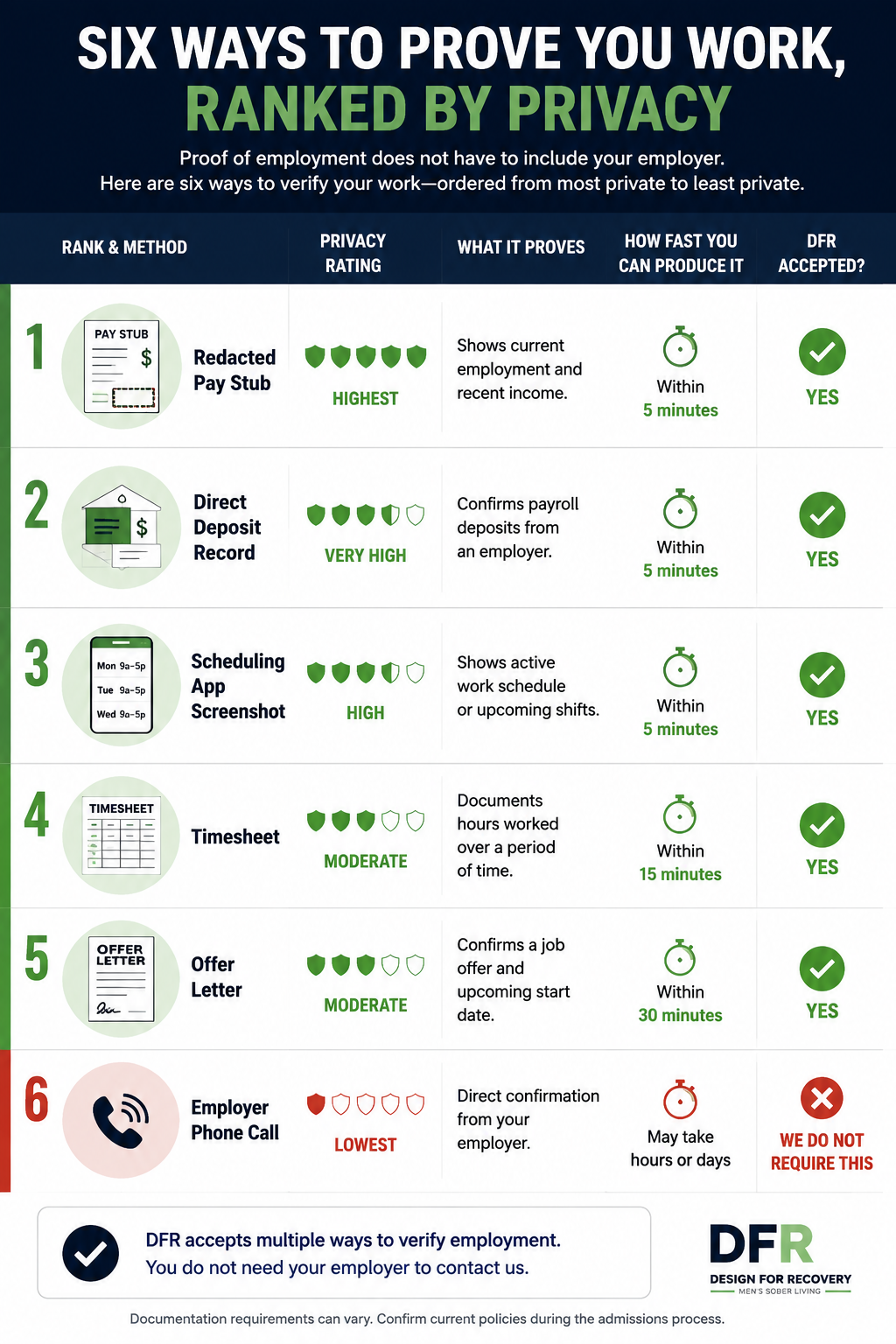
Several documents may help establish employment or income without requiring a direct call to your employer.
Depending on the program's current requirements, examples can include:
- A pay stub: Personal information that is not needed for verification can be redacted.
- A direct-deposit record: This can show payroll income entering your account.
- A scheduling app screenshot: An active schedule can demonstrate that you are currently working.
- A timesheet: Documented hours can provide evidence of ongoing employment.
- An offer letter: This can show that you have accepted a position and are preparing to begin work.
- Tax documents: Contractors and self-employed workers may use income documentation instead of traditional pay stubs.
The key is to provide enough information to establish employment without unnecessarily handing over additional personal information.
Before submitting a document, ask the house what it actually needs to see. You may be able to redact information that has nothing to do with employment verification.
Why an Employer Letter May Not Be the Best Option
A letter signed by your boss may seem like an easy way to verify employment.
The problem is what happens when the request goes beyond confirming that you work there.
If a sober living program asks your employer to confirm your employment because you are entering sober living, your employer may learn about your living arrangement in the process. You may not have chosen to share that information at work, and you may prefer to keep your recovery and housing situation private.
That does not mean you are refusing to prove that you have a job.
You are asking whether the same information can be verified another way.
A pay stub can show that you receive income. A work schedule can show that you are actively working. A timesheet can document hours. An offer letter can establish that you have accepted a position.
None of those methods necessarily requires your employer to become involved in your housing decision.
What If You're Self-Employed, a Contractor, or Between Jobs?
Not everyone earns income from a regular employer. Contractors, freelancers, gig workers, and self-employed people may use invoices, contracts, payment records, or tax documents to show current work and income.
Before moving in, ask:
- How long do I have to find a job?
- What counts as proof of an active job search?
- Do applications or interviews need to be documented?
- What happens if I have accepted a job but have not started yet?
The important thing is to explain your employment situation during admissions and find out what documentation the program accepts.
What to Say If a House Insists on Contacting Your Employer
If a sober living residence asks to contact your employer, you do not have to turn the conversation into an argument.
Start by asking what information they actually need.
You can say:
"I understand that you need to verify my employment. I'm happy to provide documentation such as a recent pay stub, work schedule, timesheet, or other proof of income. I would prefer not to disclose my sober living situation to my employer. Can I provide one of those documents instead of having my employer contacted?"
That keeps the conversation focused on the actual requirement.
You are not refusing to prove that you work. You are asking whether the same requirement can be satisfied without an unnecessary disclosure.
If the residence still requires employer contact, ask for the policy in writing and ask whether there is an alternative verification process.
Clear policies are useful because residents should understand expectations before moving in.
What Employment Verification Looks Like at Design for Recovery
Design for Recovery treats employment verification as part of establishing stability while respecting the separation between a resident's workplace and living situation.
DFR does not require an employer phone call to prove employment.
The purpose is to verify that a resident meets the program's employment expectations without making the employer part of the resident's sober living arrangement.
You may need to show that you work. You do not necessarily need your boss to know where you live.
The exact documents accepted for verification should be confirmed with DFR during the admissions process. Requirements can vary based on an applicant's employment situation, so it is better to ask than to assume a particular document will be accepted.
Ask the Right Questions Before You Choose a Sober Living Program
Employment verification shouldn't come with uncertainty. Before choosing a sober living home, make sure you understand exactly what documentation is required, whether alternative forms of verification are accepted, and how your personal information will be handled.
At Design for Recovery, we believe expectations should be clear from the beginning.
Our admissions team is available to answer questions about employment requirements, accepted documentation, and every step of the move-in process, so you know exactly what to expect before making a decision.
- Why Houses Verify Employment
- Do You Have to Tell Your Employer You Live in Sober Living?
- Verification Methods That Do Not Involve Your Employer
- Why an Employer Letter May Not Be the Best Option
- What If You're Self-Employed, a Contractor, or Between Jobs?
- What to Say If a House Insists on Contacting Your Employer
- What Employment Verification Looks Like at Design for Recovery
- Ask the Right Questions Before You Choose a Sober Living Program
Begin Lasting Sobriety Now!